

AI Visibility and Search Rankings: Separating Google Fact From SEO Hype
One of the latest trends in digital marketing strategy is AI Visibility, the push to optimize your website and content to appeal to AI search platforms. The goal of website optimization used to be to rank first, or at least within the top 10, on the first page of the search engine results page (SERP). You wanted your business to be front and center when potential customers came looking for what you sell.
If you’re at the top of the SERP right now, you may be greatly concerned about maintaining that rank. After all, over the years you’ve been in business, you’ve probably invested quite a bit of time and money securing that first-place ranking. So if you’re reading any one of the thousand articles being published on “how to optimize for AI” or “how to rank in AI search,” your fear of losing that spot may be profound. Where do you start with changes? How much of your website will need to be updated? And what should you prioritize first?
Before you panic, remember that short-term trends will always come and go, but clarity and strategy are long-term. That is not to say AI is going anywhere, it’s not. Its influence is only going to grow and both individuals and businesses will have to learn to survive and thrive in this AI revolution. But today’s changes to digital marketing strategies directed at visibility for your business aren’t quite as substantial as it may feel today. Let’s look at what is actually true in terms of AI versus the thousands of articles being published that are driving some of that fear.
What is AI?
The AI platforms used by the public are not technically artificial intelligence. They’re Large Language Models (LLMO) that are based on Generative AI science. These platforms respond to a user prompt by scanning the sources available to it, processing the results and providing a coherent answer. Still, these LLMO tools are globally referred to as AI at the moment.
Before you dive into relying on any AI platform for information, it’s important to remember that while the AI-generated results that are returned from your prompt may be stated with authority, they’re not necessarily correct. At this point in its evolution, AI is still simply gathering and regurgitating information. It cannot “think” and has no way of knowing if what it says makes sense or is logical! Always double-check for accuracy before you publish any AI-based content.
Currently, users can get answers from AI in a few different ways, and there are multiple platforms to access them. Right now, for the everyday user, the two most popular AI gateways are ChatGPT and Google.
Ranking on ChatGPT

You may be familiar with several AI platforms like Claude, Perplexity, and Microsoft’s Copilot. Each works similarly and may even provide similar answers, but when you compare activity, none of them come close to the powerhouse that is ChatGPT. It’s by far the most popular AI chatbot, processing around 6 billion queries each month.
The closest competitor, Google’s Gemini, receives just under 750 million. That positions ChatGPT with 8x the amount of monthly activity. While Google’s search engine still dominates with around 83.8 billion queries monthly, your customers *are* using AI platforms and, in reality, they’re most likely choosing ChatGPT.
AI Visibility is the term used by web marketing and SEO professionals to refer to business that show up in results when somone is using ChatGPT or any other AI Tool to search the web.
These days, use cases for ChatGPT include generating documents, conducting research or receiving a thorough explanation on a specific topic. But, unlike a Google search, when you ask a question, you don’t need to sift through dozens of articles that may not address your needs directly. When using ChatGPT, the research is synthesized for you and presented in a digestible format. If you need further clarification or have a further question on the same topic, rather than a completely new search, ChatGPT will continue the conversation. But that’s nowhere close to the limits of the platform’s usability, especially in marketing.
A September 2025 study from Adobe showed that 36% of the people surveyed had found a new product using ChatGPT as their search engine. This makes sense because ChatGPT basically acts as a reference librarian from the olden days who not only answered your questions but also directed you to additional resources to enhance your search. ChatGPT is simply more helpful and usable than traditional search.
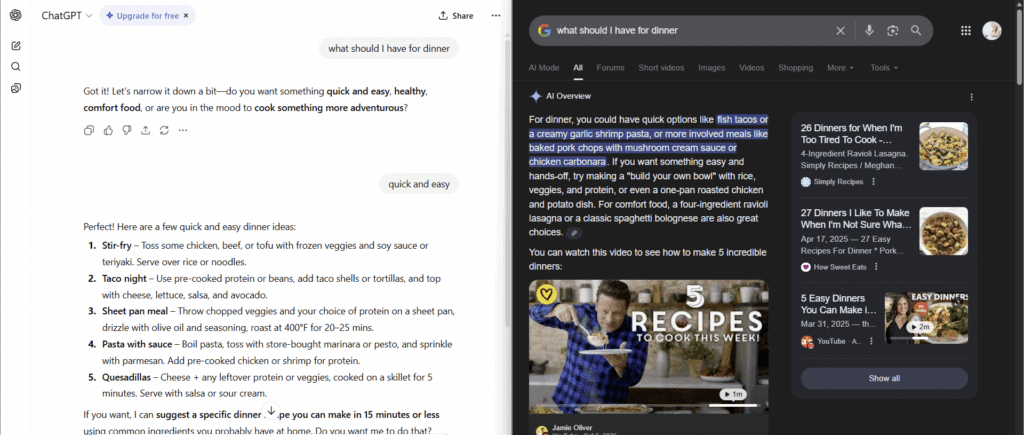
When you give ChatGPT a prompt, what you get back is designed to be conversational, helpful and, in some cases, can mimic intimacy. The expectation is that you can ask simple questions and receive a response that will return an actionable answer. The initial few lines are typically a friendly chat preamble filled with encouragement or praise that are intended to set the tone of the interaction. Next, ChatGPT answers your question, along with providing references. But the AI chatbot doesn’t stop there. For many users, the appeal of ChatGPT is that it follows up by suggesting next steps.
The natural language, back-and-forth interaction and the addition of further guidance are what draw people to ChatGPT and away from the standard Google search. ChatGPT is designed to look at multiple sources across the web and present one coherent answer, a task that could take several minutes or even hours on Google.
Ranking on Google
Throughout 2024 and 2025, Google rolled out the AI Overview format (formerly Search Generative Experience (SGE)) powered by Gemini. Eventually, for every Google search you undertake, the top spot on the SERP will be taken up by AI-generated results summarizing the topic, with two or three of the supporting reference articles to the right. If you click on one of these articles, you’ll be taken to that website where the relevant information is highlighted.
Next on the SERP, you’ll see the Sponsored Results section. The companies displayed here have paid to promote their content using Search Ads. In third position on this first page of the SERP, you’ll find the first organic result, followed by a list of AI summaries of questions “People Also Ask.” Finally, the remaining organic results will be displayed.
According to Google, the intention of the AI Overview isn’t to replace organic results. Rather, it’s a way to save users time and create a place to start for further research. But what is intended is often very different from what actually happens. As of August 2025, Google’s AI Overview is triggered on queries around 30% of the time and organic click-through-rates have dropped by 34.5%. So, while 70% of queries still display the traditional organic results that depend on search engine optimization (SEO), that percentage will surely continue to decrease as each iteration of the AI improves.
Given the ubiquity of AI-powered search, it’s not surprising that the Adobe study mentioned above also found that around 66% of businesses are planning to shift their marketing focus to AI in the coming months. To remain competitive in your marketplace, and to learn what that shift actually entails, you should have a basic understanding of how Google and ChatGPT pull the results they display.
How to rank for AI, according to the experts
There’s no shortage of SEO experts publishing articles every day on how to rank for what they’re calling Generative Engine Optimization (GEO). The basis of this approach is to optimize your content for visibility on AI platforms. In some of these articles, you’ll read that AI is “rewriting search” or that “SEO is dead” and you’ll see advice ranging from including AI-focused keywords, establishing a conversational voice and tone and using structured data to adding a table of contents or placing a FAQ in the content you publish.
Much of this popular advice is actually correct and may continue to be relevant to AI searches in the future. There’s no doubt that the structured data will help any search engine or AI platform understand your content more effectively. SEO keywords still matter. A conversational tone with short sentences and a clear purpose provides clarity for AI but is more engaging for readers. And the addition of a table of contents and frequently asked questions summary can attract attention that improves the user experience of your content. Together, these components may make your site easier to analyze by AI. But they’re also the same fundamentals as SEO.
Some of what the experts say is contradicted by Google and OpenAI, the parent company of ChatGPT. In July 2025, well-known Google analyst Gary Illyes said, “To get your content to appear in AI Overview, simply use normal SEO practices. You don’t need GEO, LLMO or anything else.” OpenAI states that ChatGPT uses third-party search engines to gather the information it uses to provide its summarized answers.
Moving forward with AI Visibilty
ChatGPT and Google’s AI Overview do have an impact on search results and click-through rates, but a GEO cannot replace your SEO strategy. Google continues to put an emphasis on expertise, authority, high-quality and helpful website content rather than looking for a shortcut or magic want to AI visibility.
Businesses that succeed aren’t those that change strategy unnecessarily and chase trends. They work with experts who understand the latest developments in search and adapt as needed.
Need help understanding the impact of AI on your business? Talk with one of our marketing experts today!