


The New Role of Keywords in Today’s SEO Strategy
Unfortunately, the perfect search engine optimization (SEO) for your business website is a target that never stops moving. Every year (and sometimes more frequently), you must consider new technologies, algorithm updates, and changing customer behaviors, and revise your SEO strategy accordingly. Currently, one of the most contentious topics in SEO, particularly in light of the significant influence of AI, is how, where, and whether to use keywords.
As disappointing as the answer may be, keywords do still matter, just not in the same way they mattered a decade ago. The current approach to SEO is far more strategic and organic, making the old keyword strategies completely irrelevant. To beat your competitors for the top spots on the search engine results page (SERP), you need to understand not only why keywords matter but also how to use them effectively.
How Keywords Have Evolved
At the turn of the 20th century, claiming one of the top three positions on the SERP was ridiculously simple. You could make an educated guess on the words customers used to search for your products or services. Then you used them over and over… and over… throughout your website, maybe even hiding extra keywords in your footer. With those tactics, you’d have a pretty decent chance of getting clicks. In the era of keyword stuffing and black-hat SEO, the concept of a genuine strategy for keywords was barely applied.
Of course, that time is long gone. Search engines quickly realized customers didn’t want to use websites that were clunky to navigate and cluttered with irrelevant references and overly nested navigation bars. With Google leading the industry in protecting users from low-quality websites, its algorithms have become more sophisticated. Beginning in 2010, three significant updates targeting keywords and content significantly altered the SEO landscape.
Major Google Algorithm Updates
In 2011, the Panda update started filtering out low-quality content. You could no longer try to purposefully manipulate your website copy to raise your position on the SERP. Also, the number of inbound links to your site started having a greater impact on rankings. Of course, spammers adjusted their strategies to match, so Google couldn’t stop there with their updates.
The Penguin update in 2012 addressed tactics that artificially raised the number of inbound links to a website. Paying for backlinks, link farming, and automating links caused search engines to downrank or delist your site. Real, quality content became even more important for ranking high on the SERP.
In 2013, Google’s Hummingbird update put a greater emphasis on natural language queries, with context and meaning becoming more critical than individual keywords. Hummingbird enables Google to conduct a more in-depth analysis of a website, resulting in users being directed to pages that are more closely aligned with their search queries, rather than just home pages.
That means that for the last decade or so, search engines have become less focused on individual keywords and more on context and intent. A keyword strategy that works in 2025 is less about isolated terms and more of an ongoing conversation with potential clients. Now, rather than matching a search word to a blog article title, Google understands what the user meant when they entered their query and returns more relevant results.
If you’re still using outdated tactics like writing your content to conform to specific keywords, then your website is almost certainly failing to generate leads or conversions!
Changing the Keyword Paradigm
One of the most significant changes to keyword strategy is that clicks and impressions within Google are less of a priority. Before the advent of AI, informational articles were the primary method of attracting users to websites. If a user asked Google a question like, “How can I deal with rain on my wedding day?” articles from wedding planners, wedding supply companies, and venues popped up on the SERP. The first few articles typically garnered hundreds, maybe even thousands of clicks. If those articles resulted in conversions then they certainly won’t now.
Today, there are still suggested articles on dealing with inclement wedding weather on the first page of the SERP. However, the prominently displayed AI Overview provides a clearly laid-out plan to prevent disaster, along with multiple suggestions on how to handle a rainy wedding day if it does occur. The informational articles are no longer receiving clicks, let alone conversions.
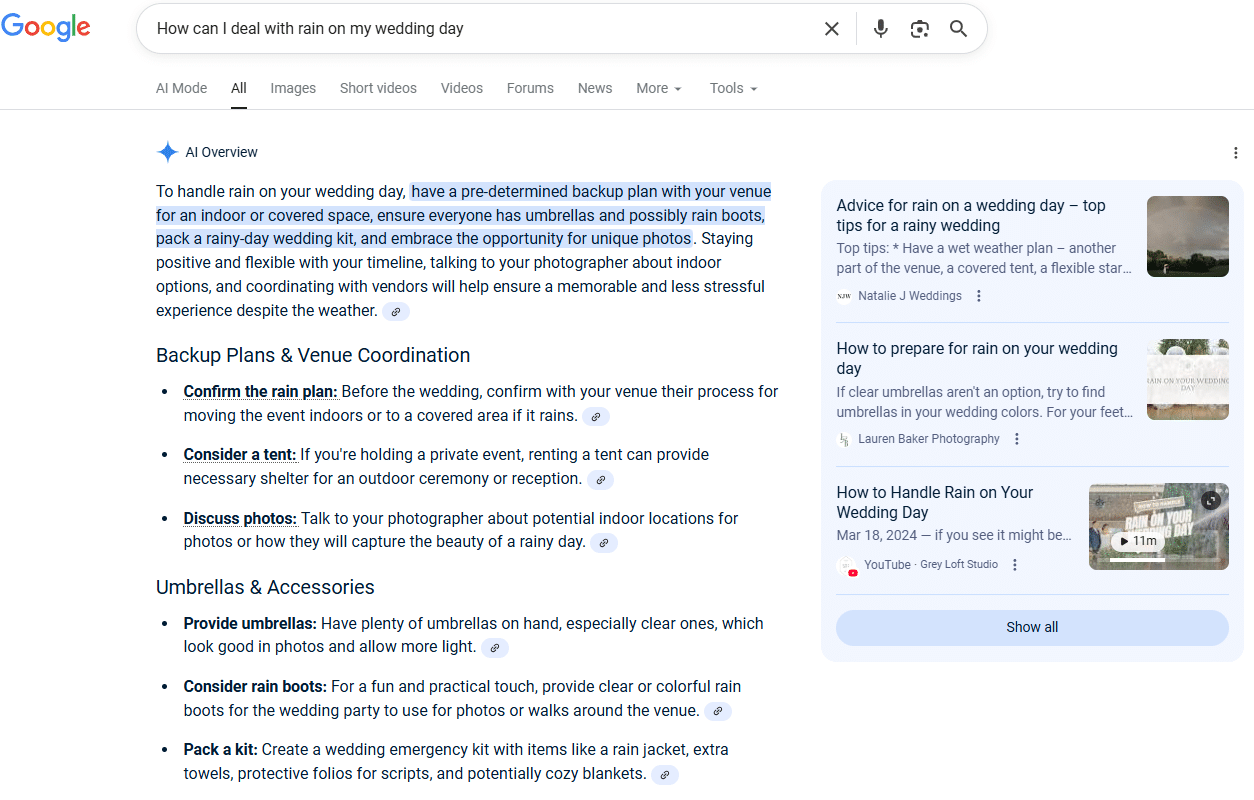
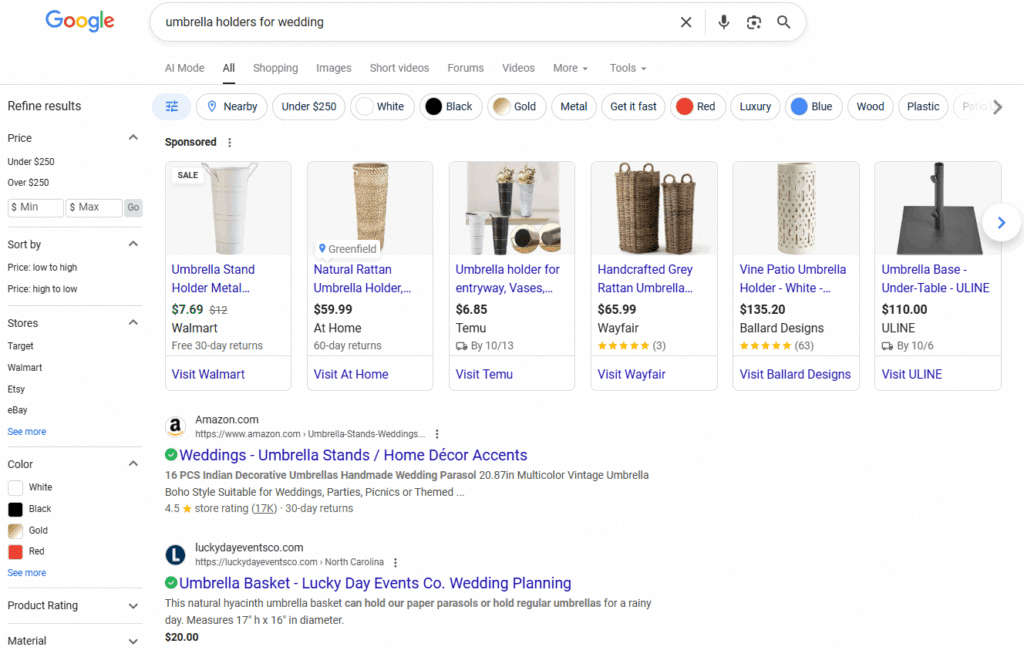
With the comprehensive results of AI so readily available, the goal is no longer for keywords to direct users to information. Instead, you have to provide solutions. The wedding supply company that prioritizes the keywords “buy wedding-friendly umbrellas” or “umbrella holders for weddings” is the business that will get the sale.
Using Keywords in 2025
In 2025, Google’s algorithm will be more potent than ever before. The search algorithm is capable of interpreting a user’s intent, analyzing their behavior, and using their past searches to provide answers. So, although keywords do still play a supporting role, they’re no longer the star of SEO.
The best way to change your thinking around how to use keywords is to stop thinking of them as words. Keywords aren’t a single word or even a phrase; they’re better understood as a signal of intent. They can help you understand what your potential customers are looking for, how they look for it, the problem they need to solve, and what type of solution they want. Your content must be the bridge between what your customer is asking for and your product.
SEO Strategy in 2026
When you’re planning an SEO strategy, you have to start somewhere, though. Researching keywords can help you learn what your audience is looking for. They can guide your copy toward answering questions and addressing challenges your customers want to solve. Knowing what your customers are searching for remains essential because you want to position your business as the solution.
For example, if a user is looking for “best manufacturer website design examples,” Google won’t scan thousands of pages for that exact phrase. Instead, the search engine analyzes the user’s intent when they conduct that search. When they ask that question, what do they actually want to know? Most likely, they want to see case studies, galleries, templates, and design inspiration for manufacturing websites.
To catch the eye of a user looking for a company that designs websites for manufacturers, write an article featuring real-world examples of effective design samples. It will have a much higher chance of appearing in the “website design examples for manufacturing company” search results than a service page that sprinkles the phrase “manufacturer website design” throughout.
Keywords Mistakes To Avoid
If you believe you’re one of those business owners who haven’t kept up with advances in SEO strategy, there are some outdated approaches you can avoid.
1. Overusing a keyword – Twenty years ago, using a keyword seven to nine times on a webpage was the cutting edge of SEO tactics. Now, both readers and search engines see it as a sign of low-quality content.
2. Using broad keywords – Choosing one-word keywords that are too vague or competitive is pointless. Research the topics that interest your audience rather than creating copy around individual keywords.
3. Ignoring search intent – If your audience is looking for a how-to guide, but you provide a highly technical and dense white paper, you’ve mismatched on search intent. You’re not giving the user what they want, and they’re unlikely to remain on your site.
4. Not updating the strategy – Every piece of your digital marketing strategy needs regular updates, but especially your SEO strategy. Changes in customer language, newly released search algorithm updates, and emerging competitors can render your approach to SEO quickly outdated.
Avoiding these mistakes doesn’t require advanced technical skills, but it does mean being more intentional with how you use keywords.
So, Do Keywords Matter?
The answer is yes, but not in the same way they did even a few years ago. Keywords are less about repetition and more about connecting with intent. They help a search engine understand what you’re selling, and customers find the solutions they need.
So, while you can’t abandon your keywords, you also can’t hold on to outdated practices. You have to keep up with how search engines are changing, how customers are looking for you and how they’re finding your website.
Is your current keyword strategy helping or hurting? Talk with one of our marketing experts today to get clear on what’s working—and what isn’t.