

The Reason Your Leads Aren’t Turning Into Sales
When a potential client enters your lead pipeline, your expectation is always going to be the same. They’ll move steadily forward until a commitment is made and they make a purchase. From awareness to consideration to decision, each step they take builds on the last as they steadily progress.
If you’re thinking, “Wouldn’t that be nice? But most of our leads stall, slow down, or drop off before they convert!” then you have a problem. Something is interrupting your sales cycle, and it needs to be addressed quickly. So many businesses invest in digital marketing that generates a strong initial interest but fails to turn that energy into a closed deal.
When the issue isn’t lead volume, the problem is what happens after those leads enter the customer journey. Data shows that many B2B customers are about 70% through the purchasing process before they speak to sales. That means marketing takes on the work of building the foundation, and sales has to come in with the right approach at the right time to close the deal.
Leads don’t always stall because they aren’t interested. They often stop because something makes it difficult to move forward. And a misaligned customer journey is one of the most common reasons. Here’s how to identify why, where, and what to do about it.
Why leads stall before they convert
Most stalled leads aren’t the result of just one weak link in the chain, which can make figuring out how to update your sales cycle difficult. More often, there are multiple small challenges that add up to interrupt the customer’s forward momentum. These disruptions can create doubt, hesitation, or even cause the lead to disengage completely. Because each one seems minor, you can miss the cumulative effect.
Let’s look at a few common scenarios where leads stall in the sales pipeline.
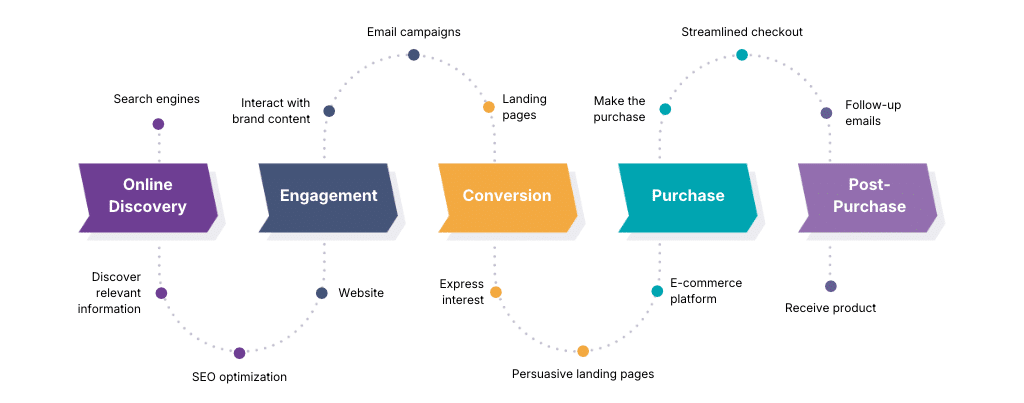
Scenario 1: Breakdowns in the awareness stage
During the awareness stage, a potential customer downloads your lead magnet, but your follow-up emails aren’t timed correctly or aren’t fully personalized. Your carefully crafted drip campaign may actually include too many (or too few!) emails. At the same time, there’s no clear handoff to sales or context around the lead’s behavior. Either way, the client loses interest and moves on before ever speaking to sales.
Scenario 2: Misaligned messaging in the consideration stage
Another possible drop-off point is in the consideration stage. Here, the lead moves through the early phases of the sales cycle but receives the right content at the wrong time. While they’re still in research mode to understand their options, your messaging switches from helpful content to sales content—a tonal whiplash that can feel abrupt. When your messaging shifts too early, a potential customer might be turned off by what they feel is a hard sell. Rather than continuing through the process, they pull back.
Scenario 3: Disconnects between marketing and sales
Even if a lead moves smoothly between marketing and sales, there can still be a disconnect that loses the client. Inconsistent messaging, an unclear customer pathway, or even failures in internal communication can interrupt progression. Without a defined path forward, the buyer pauses, reassesses, and starts exploring alternatives.
These kinds of breakdowns are more common than it seems. Research shows that poor timing, misaligned messaging, and a lack of clarity in the customer journey are some of the more frequent reasons leads stall in the sales pipeline.
What’s less common is for a stalled lead to be the result of a single problem. More often than not, a stalled lead is caused by an accumulation of small missteps that stopped their forward movement. What looks like a poor quality lead is actually an ineffective customer journey.
What happens when marketing and sales are out of sync
The handoff from marketing to sales can be one of the most impactful weak points in a sales cycle. Again, timing is everything, and if the timing is wrong, sales momentum can be lost. Both rushing a lead and ignoring them have the same outcome: no deal.
A clear transfer process, including the relevant information collected about the customer during the marketing phase, should be in place. The sales team needs to know the interaction history and demographics to approach a customer appropriately. Hyper-personalization is required in 2026 and it’s not relegated to the marketing phase. If sales doesn’t understand the lead’s motivation or history, the conversation can lose direction before it even begins.
A tonal whiplash of messaging between marketing and sales can be another challenge. A digital marketing strategy is intended to build brand familiarity and trust. If that messaging changes when sales takes over, potential customers can be disoriented by the mismatch. In that case, they might turn to another business that has a more comfortable process.
Issues like these aren’t simple internal inefficiencies. They interrupt the customer’s progression through the sales cycle and indicate a disconnect between your teams and how potential customers make buying decisions.
What stalled leads are costing your business
A pause in the sales cycle means a pause in the customer journey. This is especially dangerous during hand-offs, from prospecting and qualifying to presentation and closing. In a competitive market, when interest is high, but transitions are bungled or next steps unclear, leads stall and sales are lost.
In later stages, if sales and marketing aren’t on the same page with messaging, the sales team can get caught up re-explaining your product and revising customer expectations rather than advancing the purchasing decision. The buyer can feel like they’re not getting the experience or solution they were promised. The information they’re receiving might feel repetitive or irrelevant, adding friction to their customer journey until they’re too frustrated to continue.
When potential customers aren’t shown a clear way forward, even strong leads can lose momentum. In many cases, the issue isn’t a lack of interest. Rather, it’s a lack of direction that first evolves into hesitation and then into inaction.
Misalignment between departments can also lead to uncoordinated communication. Timing is everything in sales, and leads need to hear from your business regularly in order to push forward. Lengthy pauses in communication with the customer mean weakened engagement. As a result, responses from the customer grow more and more infrequent until the lead is lost.
As leads fall off, these slowdowns fill your pipeline with potential deals that aren’t moving forward. That means fewer sales, decreased revenue, and low morale across all departments.
What a strong customer journey should look like
When sales and marketing are aligned, leads move through the sales cycle efficiently. Their experience feels consistent, intentional, and safe. Each interaction builds on the last. Marketing doesn’t just attract attention and create leads, it also prepares those leads for what comes next. With clear expectations, buyers feel more comfortable transitioning to sales.
When sales steps in, they’re building on a solid foundation rather than restarting a conversation. They can focus on addressing specific needs, guiding the buyer toward a resolution, and clearly communicating next steps. They don’t need to educate the buyer about the product or convince them of the value. Maintaining continuity means the process keeps moving.
In a healthy customer journey, messaging is consistent across every stage. What the lead sees early reinforces what they hear later, building trust and promoting clarity. They feel confident in your ability to provide them with the right solution.
Overall, each interaction with your company should have a clear purpose and desired outcome. You’re continuing to engage the lead for relevant reasons that move them closer to a decision. Your sales team is actively pursuing qualified, engaged leads rather than fighting to renew lapsed interest.

How to repair your sales cycle
You can’t repair and strengthen your customer journey without knowing where the problems are. More leads isn’t always the answer.
Start by analyzing your sales pipeline and identifying exactly where leads typically pause or drop off. These are the points that highlight gaps in timing, messaging, or the handoff between marketing and sales. Once you pinpoint the problem, you can start looking for a fix.
From there, focus on creating a more structured and consistent customer journey. Each stage should include a clear next step, a designated owner, and content that accurately reflects where the potential customer is in their decision-making. When those three elements are in place, your marketing and sales team will have a much easier time preventing leads from stalling.
Strengthen your customer journey
Leads don’t just vanish. When they fall off, it’s usually a sign that something in your customer journey is blocking their way forward. And the reason isn’t always obvious.
The wrong timing, messaging, and handoff can build over time, slowing their progress until the opportunity for a sale is gone. Address those issues, and the entire process becomes easier to navigate for both your potential customers and teams.
A strong digital marketing strategy doesn’t just generate leads. It also guides them seamlessly through the customer journey. When the path is clear, your sales potential grows.
If you’re ready to get your sales pipeline moving, talk with one of our marketing experts today!


